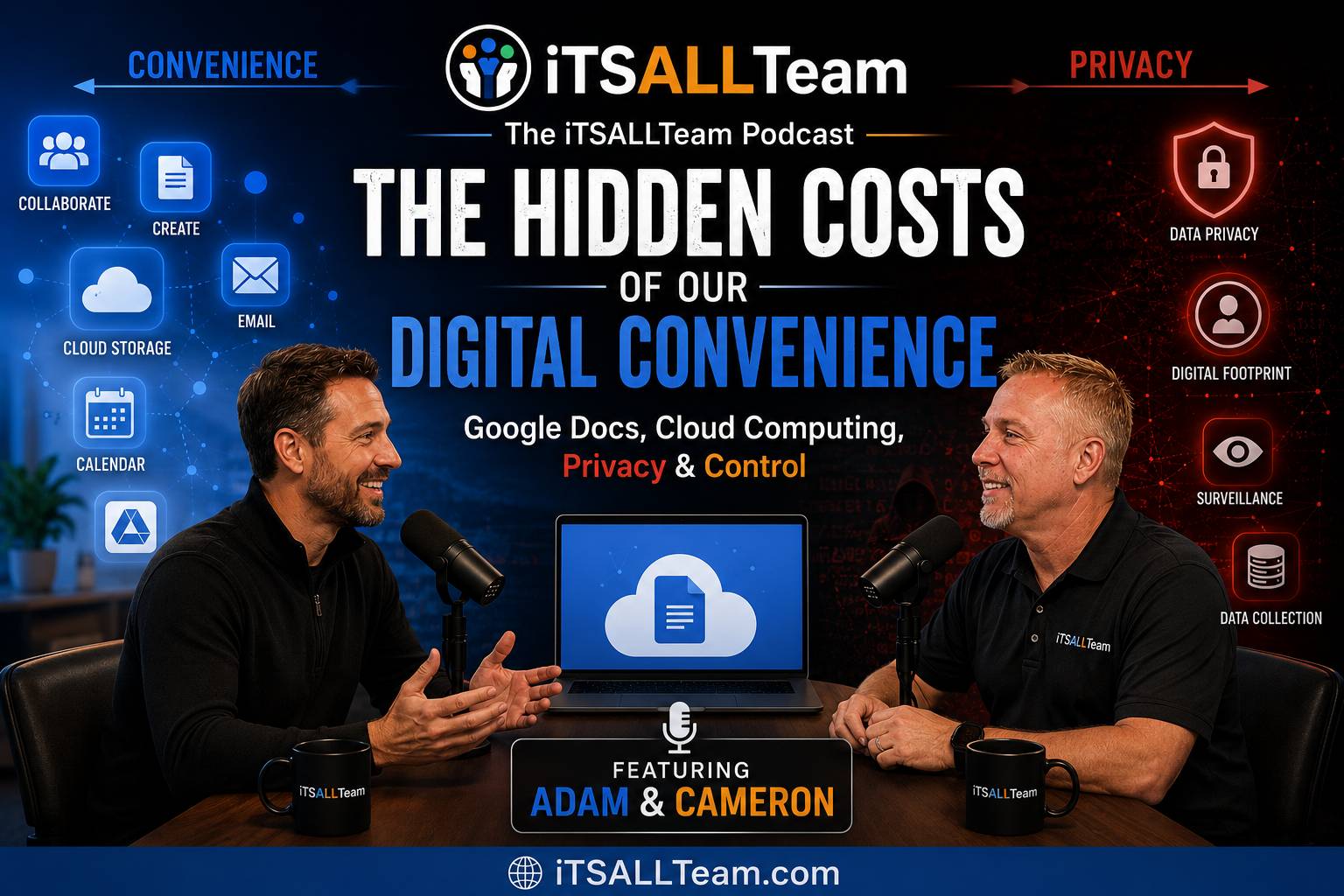
The Hidden Costs of Our Digital Convenience
Click Play ▶ to listen to this iTSALLTeam Podcast.
Your invited to download and share all of The iTSALLTeam Podcasts.
Host: Adam
Special Guest: Cameron L Proulx
Audience: Generation X Network Marketers
Length: Approximately 8 Minutes
Episode Title: “The Hidden Costs of Our Digital Convenience"
Adam
Welcome to the iTSALLTeam Podcast. I am Adam, and today, I have Cameron joining me here to talk about, The Hidden Costs, of Our Digital Convenience
Ok, so here’s something to think about—Google processes over 3.5 billion searches every single day. That’s more than 40,000 searches per second. And yet, for most of us, the real power of Google isn’t in the search bar—it’s in the tools we use every day, like Google Docs.
Cameron
Oh, that’s such a great point. Google Docs is one of those things that’s just… there. It’s so integrated into our lives that we barely even notice it anymore. But when you stop and think about it, it’s kind of amazing how much we rely on it, especially for collaboration.
Adam
Exactly. And what’s fascinating is how it’s not just about Google Docs as a standalone tool. It’s about how it fits into this massive ecosystem of apps and services. You log in with your Google account, and suddenly, you’re connected to everything—Gmail, Drive, Calendar, YouTube. It’s all tied together, and it all starts with that one account.
Cameron
And that interconnectedness is both brilliant and, let’s be honest, a little unnerving. I mean, think about it—once you’re logged in, that account is available across all these apps in your browser. It’s seamless, sure, but it also raises some big questions about privacy and control. How much are we really giving up for the sake of convenience?
Adam
That’s the trade-off, isn’t it? We’ve essentially made this unspoken deal: “Okay, I’ll give you access to my data, and in return, you make my life easier.” And for the most part, it works. But there’s always that lingering question—what’s happening with all this data? How is it being used?
Cameron
Right. And I think that’s where a lot of people start to feel uneasy. On one hand, you’re like, “Wow, I love how seamlessly everything works.” But on the other hand, you’re like, “Wait a second, does Google know more about me than I do?” It’s this constant balancing act between efficiency and privacy.
Adam
Totally. And it’s not just Google, of course. It’s the entire tech ecosystem. But Google is such a central player in all of this. I mean, think about how many people rely on Google Docs alone—for work, for school, for personal projects. It’s become this indispensable tool, but it’s also a window into this larger conversation about how we interact with technology.
Cameron
And what’s so interesting is how intuitive it all feels. You open up Google Docs, and you’re just… there. Ready to write, share, edit. It’s collaborative in a way that feels almost effortless. But that simplicity is also what makes it so powerful. It’s like they’ve distilled down the essence of what people need in a word processor and then built this entire ecosystem around it.
Adam
And that ecosystem is really the key, isn’t it? Because it’s not just about writing a document—it’s about sharing it, collaborating in real time, storing it in the cloud, accessing it from anywhere. It’s a whole workflow, and it’s all tied back to that one Google account.
Cameron
Exactly. And that’s where the integration comes in. You’re not just using Google Docs in isolation. You’re using it alongside Google Drive for storage, Gmail for communication, Calendar for scheduling. It’s like this web of interconnected tools that all feed into each other, creating this seamless experience.
Adam
And that seamlessness is what makes it so powerful. But it also makes you wonder—what happens when you’re so reliant on one platform? Like, what if something goes wrong? What if you lose access to your account? It’s a lot of eggs in one basket, so to speak.
Cameron
Oh, that’s such a good point. Because we’ve all heard those horror stories, right? Someone gets locked out of their account, and suddenly, they can’t access anything—emails, documents, photos. It’s like their entire digital life is on hold, and they’re scrambling to figure out what to do next.
Adam
And it’s not just about losing access. It’s also about trust. Do we trust these companies to keep our data safe? To not misuse it? To not suddenly change the rules on us without warning?
Cameron
Trust is such a big part of it. And I think that’s where a lot of the tension comes from. Because on one hand, you’re like, “I trust Google to keep my stuff safe.” But on the other hand, you’re like, “Do I really know what’s happening behind the scenes? Do I know how my data is being used, or who has access to it?”
Adam
Right. And let’s be honest—most of us don’t read the terms and conditions, right? We just click “Accept” and move on. But those agreements are where all the rules are laid out. It’s where we’re essentially saying, “Okay, I’m fine with this,” even if we don’t fully understand what “this” is.
Cameron
And that’s the thing—most of us are fine with it, at least on the surface. Because the convenience is just so compelling. It’s hard to say no to something that makes your life so much easier, even if there’s a part of you that’s a little uneasy about the trade-offs.
Adam
Absolutely. And I think that’s what makes this such an interesting topic. It’s not just about the technology itself—it’s about how we interact with it, how we rely on it, and how we think about the trade-offs we’re making in the process.
Cameron
And those trade-offs are everywhere. Even that little detail about your Google account being available to other apps in the browser—it’s such a small thing, but it’s a reminder of how interconnected everything is. It’s like this constant balancing act between convenience and control, between efficiency and privacy.
Adam
Yeah, and it’s not just about Google. It’s about this larger shift in how we live our lives online. We’ve moved from standalone tools to this interconnected web of services. And that shift has changed everything—from how we work to how we communicate to how we think about privacy and security.
Cameron
It really has. And what’s so fascinating is how quickly it’s all happened. It wasn’t that long ago that we were using floppy disks and standalone word processors. And now, here we are, with everything in the cloud, everything connected, everything just a few clicks away.
Adam
It’s wild to think about. And it makes you wonder—what’s next? How will these tools evolve? How will our relationship with them change? And what new trade-offs will we have to navigate as technology continues to advance?
Cameron
Those are such good questions. And I think they’re questions we’ll be grappling with for a long time. Because as much as we love the convenience, there’s always that little voice in the back of our minds asking, “What’s the cost? What am I giving up in exchange for this?”
Adam
Exactly. And maybe that’s the takeaway here—that it’s okay to love these tools, to rely on them, to appreciate the convenience they bring. But it’s also okay to ask questions, to think critically, to be mindful of the trade-offs we’re making.
Cameron
Absolutely. It’s about finding that balance. Embracing the technology, but not losing sight of what’s important—our privacy, our control, our ability to make informed choices about how we use these tools.
Adam
Well said. And I think that’s a good note to end on. It’s a complex topic, but it’s one that’s worth thinking about. Because at the end of the day, these tools are just that—tools. It’s how we use them, how we think about them, that really matters.
Cameron
Totally agree. And I think it’s a conversation we’ll keep coming back to, because it’s so central to how we live our lives today.
Adam
Absolutely Cameron. Thank you for the chat.
Cameron
Same here. Until next time!
Adam
You can always find more content like this, at, iTSALLTeam.com


